

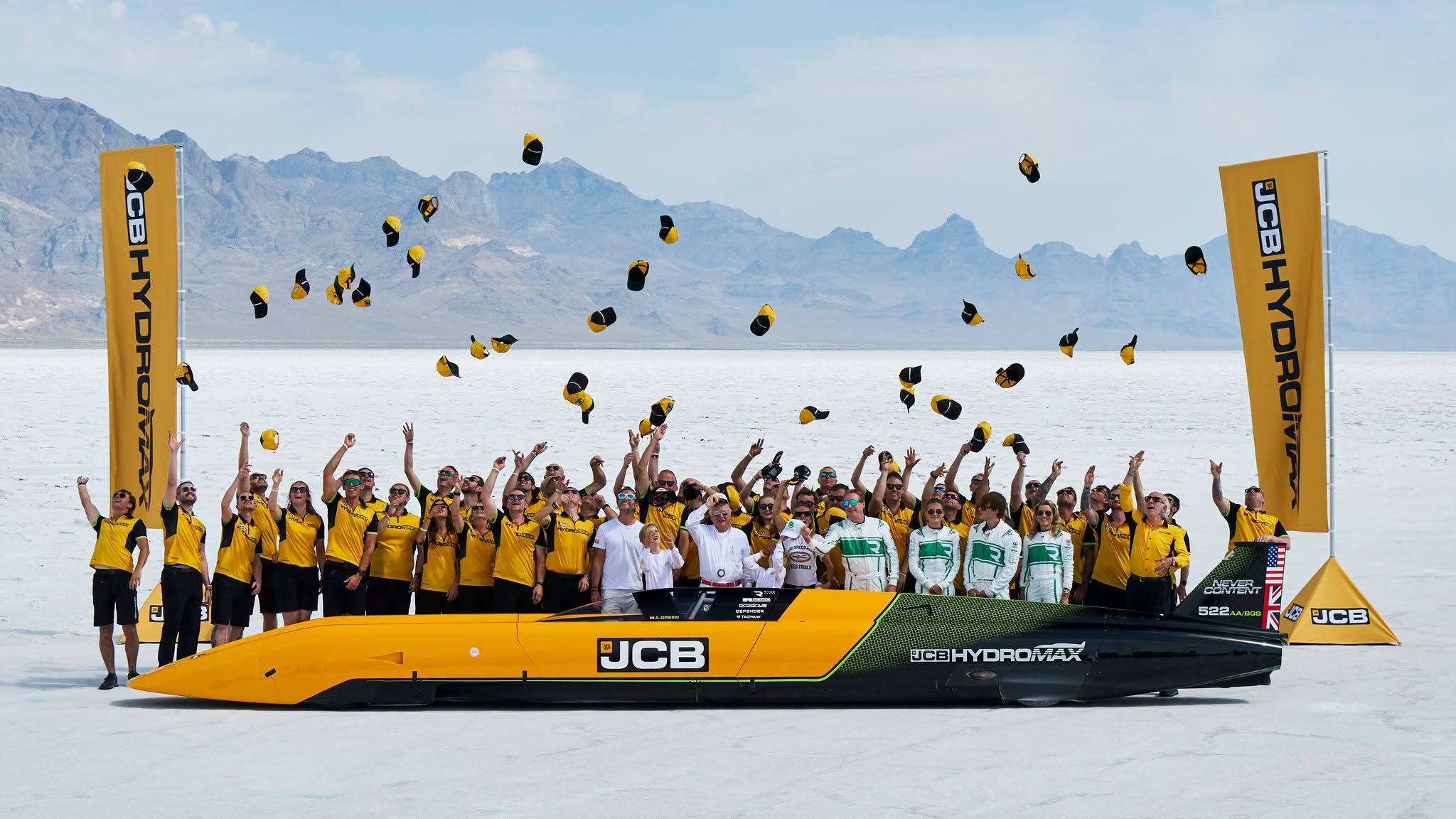
British engineering giant JCB has set a new land speed world record with the JCB Hydromax, a vehicle powered by hydrogen-powered internal combustion engines. The car reached an average speed of 649.486 km/h, becoming the fastest vehicle with a hydrogen internal combustion engine.
The record was set at Bonneville Salt Flats, in the United States, in the two races imposed by the regulations of the International Automobile Federation (FIA). In the first race, the JCB Hydromax recorded 638.286 km/h, and in the second it reached 660.686 km/h, resulting in an official average of 649.486 km/h.
At the wheel was Andy Green OBE, the driver who also holds the absolute land speed record of 1,227.985 km/h, set with ThrustSSC. Green was also the driver of JCB Dieselmax when he set the world land speed record for diesel vehicles of 563.418 km/h in August 2006.
Two JCB hydrogen engines and 1,600 hp
JCB Hydromax is approximately 10 metres long and is equipped with two JCB hydrogen-powered internal combustion engines, developed based on the technology used for the company’s machine engines.
The two units together develop around 1,600 hp and are manufactured at JCB’s engine plant in Foston, Derbyshire, UK. According to the company, they are derived from hydrogen engines developed for JCB machines.
With this performance, JCB Hydromax far surpassed the previous record for a hydrogen-powered internal combustion engine vehicle of 299.5 km/h, set by the BMW H2R in 2004.
The new performance also exceeds the 507 km/h threshold previously set for hydrogen-powered vehicles via fuel cells, which positions JCB Hydromax as the fastest hydrogen-powered vehicle of any type.
The record, set in Category A, Group XIV, Class 7 FIA World Land Speed Record, is subject to official ratification by the FIA.
20 years after JCB Dieselmax
The performance at Bonneville has a special meaning for JCB. In August 2006, on the same salt surface, the company set the world land speed record for a diesel vehicle with JCB Dieselmax, a record that remains in force.
Two decades later, JCB returns to Bonneville with a vehicle that uses hydrogen-powered internal combustion engines.
“Twenty years ago I came to Bonneville with JCB Dieselmax and showed what British engineering can do with the diesel engine. Today we did it again – this time with hydrogen-powered engines,” said Lord Anthony Bamford, President of JCB.
“This record has been set by production engines, the same engines that power JCB machines right now. That’s what JCB Hydromax is all about: to show that hydrogen works and works at the highest level today, with zero tailpipe emissions.”
Andy Green: “Bonneville is the spiritual home of the world land speed record”
Andy Green described the attempt as an important achievement for the JCB team and for the development of hydrogen-based technology.
“Bonneville is the spiritual home of the world land speed record, and JCB Hydromax has just made history. The car was great – stable, powerful and fast,” Green said.
“To set a world land speed record with a hydrogen engine, twenty years after Dieselmax, is a huge privilege. This record is a huge achievement of a world-class team and superb technology.”
For his part, Ryan Ballard, JCB’s Director of Engineering and project coordinator, stressed that the performance demonstrates the team’s ability to transform an engine for construction and agricultural machinery into a thruster capable of reaching record speeds.
“This record belongs to the engineering team that took a hydrogen-powered engine and turned it into the fastest of its kind on Earth,” Ballard said.
A new benchmark for hydrogen in motorsport
FIA President Mohammed Ben Sulayem described the performance as an important milestone for motorsport and the development of low-emission mobility solutions.
“This is a truly historic milestone for motorsport, demonstrating how innovation, performance, speed and sustainability can go hand in hand,” said the FIA President.
According to him, motorsport has traditionally played the role of a laboratory for new technologies, and the JCB Hydromax record demonstrates the potential of using hydrogen in internal combustion engines.
JCB Hydromax had already exceeded 598 km/h in Bonneville
The new FIA performance comes after just a week before JCB Hydromax had exceeded the 598.565 km/h mark during the famous Bonneville Speed Week, organised by the Southern California Timing Association (SCTA).
The race set a new SCTA record in the Blown Gas Streamliner (AA/BGS, over 500 cubic inches) class and represented an important milestone in the car’s development program.
A £100 million project
The record is part of JCB’s programme dedicated to the development of hydrogen-powered engines, in which the British company has invested around £100 million.
The engines used by Hydromax are built at JCB’s Foston plant and are based on the same core technology for the company’s machines. JCB aims to demonstrate that hydrogen internal combustion engines can be a viable alternative for applications where full electrification is difficult to implement.
The record in Bonneville also comes ahead of the opening of JCB’s new plant in San Antonio, Texas, an investment of about $500 million, which is expected to create about 1,500 jobs and produce machinery for the U.S. market.
JCB has a long tradition of speed records
JCB has built a reputation for speed records in recent years. In addition to JCB Dieselmax, which set the world record for diesel vehicles at Bonneville in 2006, the company has also set records for other vehicle categories.
In 2019, the JCB Fastrac became the fastest tractor in the world, reaching 216.26 km/h. In 2014, the JCB GT set a speed record for excavators with 113.26 km/h.
With JCB Hydromax, the company is now adding another major performance to this story: a world land speed record set with hydrogen-powered internal combustion engines.